





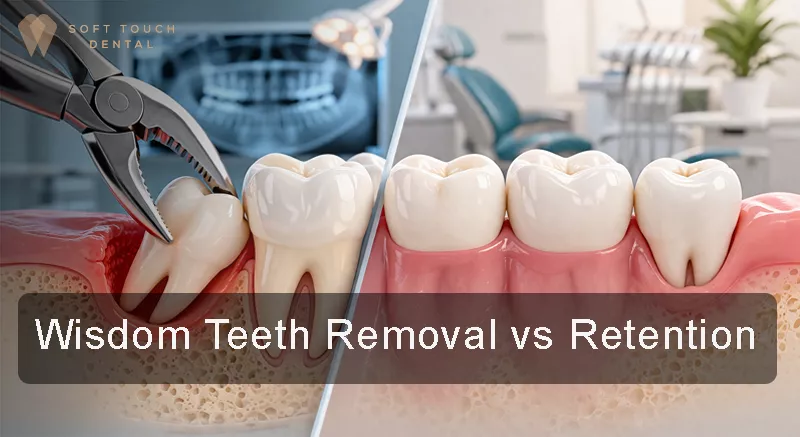
When evaluating Wisdom Teeth Removal vs Retention, the clinical decision relies entirely on the anatomical position of the third molars and their potential to cause localized pathology. Surgical removal eliminates the risk of future periodontal disease, root decay, and structural damage to adjacent teeth, particularly when the molars are impacted. Conversely, retention is a viable medical option only if the teeth are fully erupted, perfectly aligned, and can be properly maintained through daily oral hygiene.
Clinical Comparison Wisdom Teeth Removal vs. Retention
When it comes to deciding whether to remove or retain wisdom teeth, there is no one size fits all approach. This decision depends heavily on each patient’s clinical condition, the eruption status of the teeth, how easily they can be maintained with proper hygiene, and the short and long-term risks involved. While removal is often recommended to eliminate potential future issues such as impaction, decay, or damage to adjacent teeth, retention can be a reasonable option in select cases provided the teeth are fully healthy, well-aligned, and can be properly maintained. The table below outlines the key clinical factors of both approaches to help you make a more informed decision.
| Clinical Factor | Wisdom Teeth Removal | Wisdom Teeth Retention |
| Primary Benefit | Eliminates future risk of impaction, decay, and adjacent tooth damage. | Avoids surgical risks, post-operative pain, and extraction costs. |
| Primary Risk | Surgical complications (dry socket, temporary swelling, nerve damage). | High long-term risk of periodontal disease and caries on the second molar. |
| Ideal Candidate | Patients with impacted, partially erupted, or hard-to-clean third molars. | Patients with fully erupted, functional, and perfectly aligned third molars. |
| Long-Term Requirement | None; the biological threat is permanently eliminated. | Lifelong radiographic and clinical monitoring to detect silent bone loss. |
The Clinical Case for Wisdom Teeth Removal
Third molars often fail to erupt into a normal, functional position, with studies showing that nearly a quarter of people experience some form of impaction. When these teeth become trapped beneath the gum or against the adjacent second molar, they create structural and biological risks that can compromise overall oral health. For this reason, extraction is commonly recommended as a preventive measure to eliminate potential complications before they become more serious and harder to manage.
Pericoronitis Prevention
Partially erupted wisdom teeth often leave a flap of gum tissue over the crown, creating an ideal environment for food particles and bacteria to accumulate. This condition frequently leads to pericoronitis, a painful and sometimes severe gum infection that can recur if the underlying cause is not addressed. Removing the affected tooth eliminates this bacterial trap and significantly reduces the risk of repeated inflammation and infection.
Second Molar Protection
Impacted wisdom teeth can exert continuous pressure on the neighboring second molars, leading to structural damage over time. This pressure may cause external root resorption and create deep, hard to clean pockets where bacteria thrive, increasing the likelihood of advanced decay. Extraction helps protect the integrity of adjacent teeth and prevents complications that could require more extensive restorative treatments later on.
Cyst and Tumor Prevention
Although relatively uncommon, retained impacted wisdom teeth can give rise to cysts—fluid-filled sacs that develop within the jawbone. These cysts can expand تدريجاً and destroy surrounding bone and tissues, sometimes leading to more complex surgical interventions. Removing impacted teeth at an early stage minimizes this risk and helps preserve the health and structure of the jaw.
Crowding Mitigation
Wisdom teeth can contribute to the gradual shifting of other teeth, particularly in the lower jaw, where space is often limited. This forward pressure may lead to crowding and misalignment, especially in patients who have previously undergone orthodontic treatment. By removing third molars, the risk of late-stage crowding is reduced, helping maintain the natural alignment of the dental arch.
Timing also plays a critical role in the success and safety of the procedure. For patients comparing wisdom teeth removal in teens versus adults, extraction is generally recommended between the ages of 17 and 19. At this stage, the roots are not yet fully developed and the surrounding bone is less dense, which makes the procedure easier, lowers the risk of complications, and supports faster healing.
Reed More: Wisdom Teeth Removal for Teens vs Adults
The Clinical Case for Wisdom Teeth Retention
Retention, or conservative management, refers to leaving the third molars in place without surgical intervention. This approach is only clinically appropriate when the teeth are fully erupted, properly aligned, completely asymptomatic, and actively contributing to normal chewing function. When these strict anatomical and functional criteria are met, retaining wisdom teeth can offer several meaningful clinical benefits without exposing the patient to unnecessary risks.
Avoidance of Surgical Morbidity
By choosing retention, patients avoid the immediate side effects commonly associated with oral surgery. These typically include facial swelling, limited mouth opening (trismus), and painful complications such as dry socket. Eliminating the need for extraction allows patients to maintain their normal daily routine without experiencing post-operative discomfort or temporary functional limitations.
Elimination of Nerve Damage Risk
Retention fully removes the possibility of nerve-related complications, which, although rare, can occur during lower wisdom tooth extractions. In some cases, fully developed roots are positioned close to the inferior alveolar nerve, increasing the risk of temporary or even permanent nerve damage. Keeping the tooth in place eliminates this risk entirely.
Preservation of Healthy Tissue
When wisdom teeth are correctly positioned and easy to clean, retaining them helps preserve the natural integrity of the jawbone and surrounding tissues. Avoiding surgery means there is no disruption to the bone structure or soft tissue, preventing unnecessary trauma and maintaining the body’s natural anatomy.
Cost and Recovery Evasion
Opting for retention also helps patients avoid the financial burden associated with surgical procedures. In addition, there is no need for recovery time, allowing individuals to continue their normal activities without interruption or concern about healing, blood clot formation, or post-surgical care.
Read More: Signs Your Wisdom Teeth Are Coming In
The Long-Term Risks of Retention
The absence of symptoms in a retained wisdom tooth does not indicate long-term health, as evidence consistently shows a high likelihood of disease development over time. Clinical studies suggest that up to 80% of retained third molars eventually develop pathological conditions such as advanced dental caries or periodontitis by later adulthood. This elevated risk is largely due to their posterior location, which makes effective cleaning difficult and allows bacterial accumulation to persist undetected for years.
Silent Periodontitis
Retained and asymptomatic wisdom teeth are strongly associated with the gradual onset of periodontal disease, particularly affecting the adjacent second molar. Even without visible symptoms, these teeth can contribute to increased probing depths exceeding 4 mm and progressive alveolar bone loss on the distal surface of neighboring teeth. This silent progression often goes unnoticed until significant structural damage has already occurred, complicating treatment and reducing long-term dental stability.
Delayed Surgical Complications
When retained wisdom teeth eventually require extraction later in life due to decay or periodontal damage, the procedure becomes more complex and carries greater risks. Older patients are more likely to experience slower healing, higher chances of post-operative complications, and increased systemic impact compared to younger individuals. As a result, delaying intervention can transform a relatively simple preventive procedure into a more invasive and medically demanding treatment.
Active Monitoring Protocol for Retained Teeth
When third molars are retained, regular imaging becomes essential to identify hidden pathological changes that are not clinically visible. Annual panoramic radiographs or 3D CBCT scans allow clinicians to monitor root positioning, detect early cyst formation, and assess any structural changes in surrounding bone. This proactive approach ensures that potential complications are identified at an early stage, enabling timely intervention before more serious conditions develop.
Periodontal Probing and Tissue Monitoring
Consistent periodontal assessment is a critical component of active monitoring, focusing on the health of both the retained third molars and the adjacent second molars. By measuring gum pocket depths, clinicians can detect early indicators of periodontal disease, including bone loss and increased probing depths, even in the absence of pain or visible inflammation. This early detection helps prevent the silent progression of tissue damage that could compromise long-term oral health.
Oral Hygiene Capability Assessment
Maintaining retained wisdom teeth requires a high standard of oral hygiene, particularly in the posterior regions of the mouth where access is limited. Regular evaluations assess the patient’s ability to effectively remove plaque and prevent tartar accumulation around these hard-to-reach areas. If adequate hygiene cannot be maintained, the risk of decay and periodontal disease increases significantly, making ongoing assessment essential for determining whether retention remains a viable long-term option.
Final Assessment
Prophylactic extraction permanently eliminates the risk of cysts, localized decay, and damage to adjacent molars, making it the standard recommendation for impacted or inaccessible teeth. Conversely, retaining third molars avoids immediate surgical risks but mandates rigorous, lifelong clinical monitoring due to the high statistical probability of late-stage periodontal disease. The appropriate medical pathway relies on a professional radiographic evaluation of the root structure, jaw space, and eruption angle.
FAQ
Should all wisdom teeth be removed?
No, removal is not always necessary. If the wisdom teeth are fully erupted, properly aligned, and easy to clean, they can be safely retained. However, impacted or hard-to-maintain teeth are usually recommended for extraction to prevent future complications.
What are the main risks of keeping wisdom teeth?
The primary risks include a high likelihood of tooth decay, periodontal disease, and damage to adjacent teeth over time. Even without symptoms, retained teeth can lead to silent bone loss and gum disease. Long-term monitoring is essential to manage these risks.
At what age is wisdom tooth removal best?
Extraction is typically recommended between ages 17 and 19. At this stage, roots are not fully developed and bone density is lower, making the procedure easier. Younger patients also experience faster healing and fewer complications.
Can retained wisdom teeth stay healthy for life?
In some cases, yes—but only under strict conditions. The teeth must be fully functional, well-aligned, and maintained with excellent oral hygiene. Even then, regular dental check-ups and imaging are required to detect hidden issues early.
What happens if I delay wisdom tooth removal?
Delaying extraction can increase surgical risks later in life. Older patients may face slower healing, higher complication rates, and more complex procedures. Early intervention is often simpler and more predictable.