





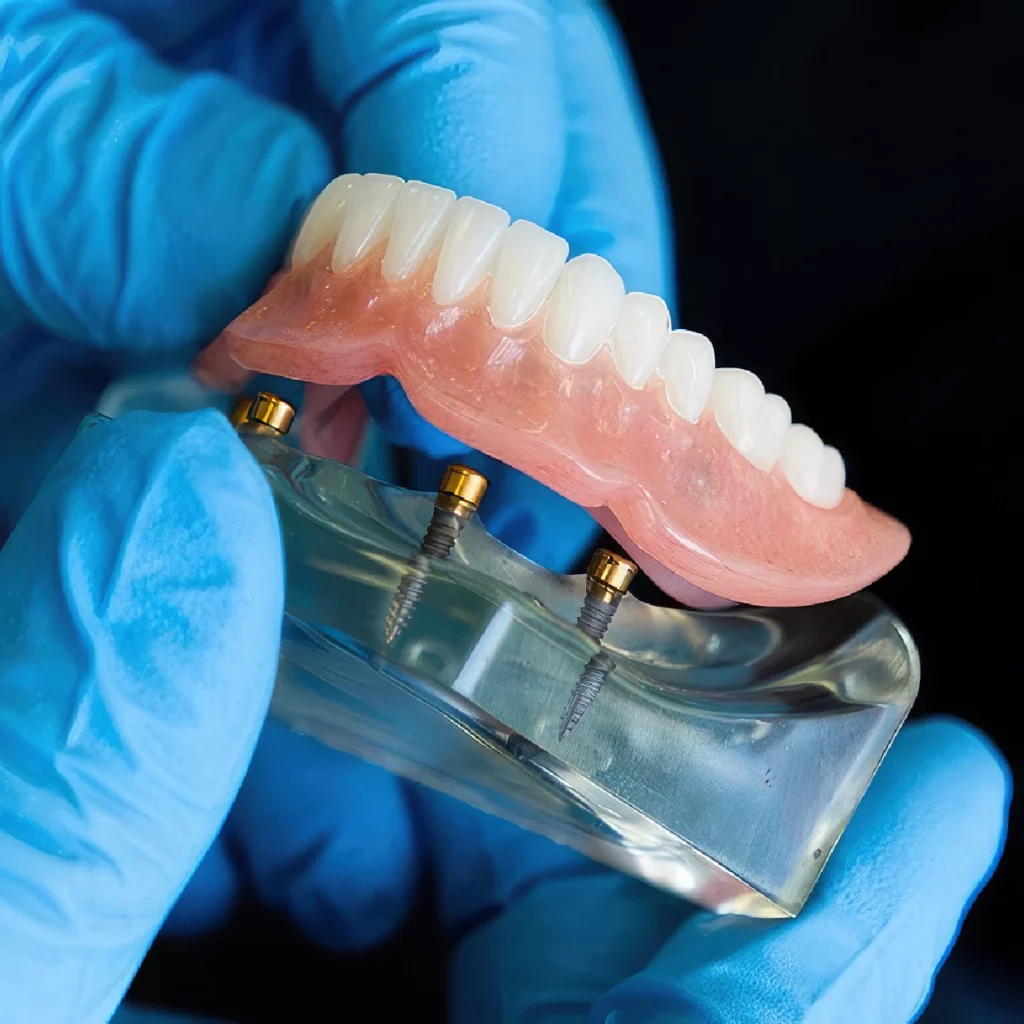
A full denture replaces an entire arch of missing teeth and rests on the gums. A partial denture fills in gaps while remaining natural teeth stay in place. An implant-supported denture snaps onto dental implants for a much more secure fit. Which one is right for you depends mainly on how many natural teeth you still have.
What Is a Full Denture and Who Needs One?
A full (or “complete”) denture replaces every tooth in an arch, upper, lower, or both, and is custom-molded to rest directly on your gum ridge, held in place by suction, a close fit, and sometimes a small amount of denture adhesive. Full dentures are typically recommended when all of the natural teeth in an arch are missing, badly decayed, or too compromised by gum disease to save.
Modern full dentures are shaped and shaded to look like natural teeth and gum tissue, and most patients adjust to eating and speaking with them within a few weeks. The main tradeoff is that, because they rest on the gums rather than being anchored to anything, they can shift slightly during eating or speaking and don’t stop the slow bone loss that naturally happens once teeth are gone.
What Is a Partial Denture, and How Is It Different From a Full Denture?
A partial denture is used when you still have some healthy natural teeth remaining in an arch. Instead of replacing every tooth, it fills in the gaps with a gum-colored base and replacement teeth, held in place with metal or flexible clasps that hook discreetly onto your existing teeth. Because your remaining teeth do most of the work of holding it in place, a partial denture is usually more stable than a full denture from day one.
Partials also help prevent your remaining natural teeth from shifting into the empty spaces left by missing teeth, which can otherwise throw off your bite over time. They’re removable, just like full dentures, so they come out for cleaning and at night.
What Is an Implant-Supported Denture?
An implant-supported denture, sometimes called an overdenture, attaches to a small number of dental implants placed in the jawbone instead of resting on the gums alone. Depending on the design, it either snaps securely onto the implants and can still be removed for cleaning, or is permanently fixed in place by your dentist. The American College of Prosthodontists notes that implant-retained dentures offer significantly more stability than traditional dentures precisely because they’re anchored rather than resting on the gum tissue alone.
Because the denture is anchored to the implants rather than just sitting on the gum ridge, it stays dramatically more stable. Patients typically describe eating and speaking with an implant-supported denture as feeling much closer to natural teeth than a traditional denture. Implants also help slow the jawbone loss that happens naturally after tooth loss, since they keep transmitting bite pressure into the bone the way natural tooth roots used to.
How Do You Decide Which Type of Denture Is Right for You?
The starting point is almost always how many of your own teeth remain. If you still have a reasonable number of healthy teeth in an arch, a partial denture is usually the right fit. If an entire arch needs to be replaced, the real decision is between a traditional full denture and an implant-supported option.
From there, the deciding factors tend to be your jawbone density (implants need enough bone to anchor into, though bone grafting can sometimes make this possible), your budget, and how important a rock-solid, natural-feeling bite is to you day to day. Patients who struggle with loose or slipping dentures, or who simply don’t want to compromise on chewing comfort, are often the best candidates for upgrading to an implant-supported denture.
How Do These Three Options Compare on Cost and Comfort?
Traditional full and partial dentures are generally the most affordable option upfront and don’t require surgery, which makes them accessible for patients who want a faster, lower-cost solution. Implant-supported dentures cost more initially, since they involve placing implants, but they offer significantly better stability, chewing force, and long-term bone preservation, which many patients find worth the investment over the life of the restoration.
Comfort tends to follow the same pattern: full and partial dentures can shift or need adhesive, especially over a long day, while implant-supported dentures stay put through normal eating and talking. A candidacy exam and cost breakdown from your dentist is the most reliable way to compare what each option would actually cost and feel like for your specific mouth.
Can You Switch From One Type of Denture to Another Later?
Yes, this is a common path. Many patients start with a traditional full or immediate denture, especially right after extractions, and later upgrade to an implant-supported denture once they’ve healed and had time to save for it or want a more secure fit. It’s also possible to convert an existing denture into an implant-retained one in some cases, rather than starting from scratch, depending on its condition and how it was originally made. Your dentist can evaluate whether your current denture is a good candidate for that kind of conversion.
Which One Is Actually Right for You?
There’s no single “best” denture, only the option that best matches how many teeth you still have, your jawbone health, and how much stability you need day to day. If you’re trying to figure out whether a full, partial, or implant-supported denture fits your situation, schedule a consultation. An exam and a look at your jawbone is really the only way to know for sure.
If you’re weighing an immediate denture right after extractions, see our guide on whether you can get dentures the same day your teeth are removed. And if you already wear dentures, here’s how to properly care for them so they last.