






Getting implants was the easy part. Keeping them healthy is what makes them last.
Knowing how to take care of dental implants is what separates patients who keep their new smile for life from patients who end up back in the dental chair a few years later. Dental implants have one of the highest success rates in dentistry — but “success” isn’t automatic just because the surgery went well. An implant is only as durable as the care it gets afterward. The titanium post itself can’t get a cavity, but the gum and bone around it can absolutely get infected if it’s neglected, and that’s the single biggest reason implants fail years down the road.
The good news: implant care is simpler than most patients expect, and it doesn’t require anything exotic. Below is the complete guide to how to take care of dental implants: the daily routine, the tools worth using, how care differs if you have a full-arch restoration like All-on-4, and the warning signs that mean it’s time to call your dentist.
Why Dental Implants Need Different Care Than Natural Teeth
It’s tempting to assume “brush and floss like normal” is enough. It isn’t quite — and the reason is biological, not marketing.
A natural tooth is held in the jaw by a periodontal ligament, a network of fibers with its own blood supply that helps fight off bacteria near the gumline. A dental implant has no periodontal ligament. It’s anchored directly to bone, and the soft tissue seal around it is thinner and has less blood flow than the tissue around a natural tooth. That makes the area around an implant more vulnerable to bacterial buildup, not less.
When plaque is allowed to accumulate around an implant, it can trigger peri-implant mucositis — inflammation of the gum tissue around the implant, similar to gingivitis. Left untreated, this can progress to peri-implantitis, which affects bone loss around the implant and is the leading cause of late implant failure. Peri-implant mucositis is common — peer-reviewed research estimates it affects roughly 4 in 10 implant patients at some point — but it’s also reversible with proper cleaning, which is exactly why the daily routine below matters so much.
How to Take Care of Dental Implants: Your Daily Routine
This is exactly how to take care of dental implants at home — the routine we walk every implant patient through at Soft Touch Dental, whether you have a single implant or a full-arch restoration.
1. Brush twice a day with a soft-bristled brush
Use a soft-bristled manual brush or a soft electric toothbrush head — electric brushes are perfectly safe for implants and often clean more effectively, as long as the bristles are soft. Avoid stiff or medium bristles and avoid scrubbing hard; the goal is to disrupt plaque, not sand it off. Brush for a full two minutes, angling the brush toward the gumline where the implant crown meets the gum tissue, since that’s where bacteria accumulate fastest.
2. Use a non-abrasive toothpaste
Skip whitening toothpastes and anything with baking soda or harsh abrasives — they can micro-scratch the implant crown’s surface, and a scratched surface actually collects plaque faster. A standard fluoride or implant-safe toothpaste is all you need.
3. Clean between and under the implant every day
This is the step most people skip, and it’s the one that matters most. Plaque between teeth and under bridge sections doesn’t come off with brushing alone. Options include:
- Floss or unwaxed tape for single implants with normal gaps
- A floss threader or Super Floss to get under an implant crown or bridge
- Interdental brushes (small bottle-brush-style picks) for wider gaps
- A water flosser — this is the single most effective tool for implant patients, and the one we recommend most. It flushes bacteria out from areas floss can’t reach, and studies show it can reduce bleeding around implants significantly more than floss alone.
4. Rinse with an antimicrobial mouthwash
An alcohol-free antimicrobial rinse (chlorhexidine, if your dentist has prescribed it, or an over-the-counter antibacterial rinse) helps control the bacteria that cause peri-implant disease, especially in the first few months after placement.
5. Don’t skip your professional cleanings
Even a perfect home routine can’t remove hardened tartar or reach every angle around an implant. Plan on a professional cleaning every 3 to 6 months, along with a periodic checkup that includes an X-ray to confirm the bone around the implant is stable. Your hygienist will also use implant-safe instruments — metal scalers can scratch a titanium or zirconia implant surface, so a good practice will use specialized plastic, resin, or titanium-coated tools instead.
Caring for All-on-4, All-on-6, and Teeth-in-a-Day Restorations
If you have a full-arch restoration rather than a single implant, your daily routine needs a few adjustments — something most generic “implant care” articles skip entirely, but it’s one of the most common questions we get from patients considering All-on-4, All-on-6, or Teeth in a Day.
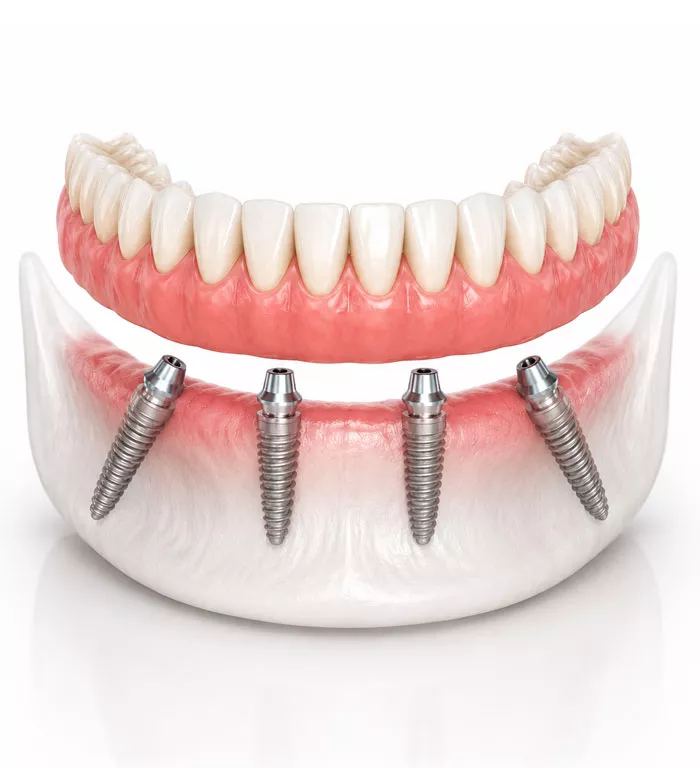
A full-arch restoration is a fixed bridge supported by four to six implants, which means there’s open space underneath the bridge, between the gumline and the underside of the prosthesis, that a toothbrush simply cannot reach.
- Use a water flosser daily, not occasionally. This is the single biggest factor in how long a full-arch restoration stays healthy. Angle the tip to flush along the gumline and underneath the bridge, moving implant to implant.
- A Waterpik implant tip or curved orthodontic brush designed for bridges makes it much easier to reach the underside of the arch, where food debris tends to collect after meals.
- Rinse after meals, not just at your two daily brushing sessions — full-arch patients often find a quick water or antimicrobial rinse after lunch prevents the buildup that’s harder to reach with a brush alone.
- Expect a different in-office cleaning process. Your hygienist may check the bridge’s clip or screw retention, examine tissue health at each implant site individually, and in some cases remove and clean under a screw-retained bridge periodically — something that isn’t possible with a single-tooth implant.
The upside: full-arch patients who stay consistent with this routine tend to have excellent long-term outcomes, since there are no natural teeth left to develop new decay — the entire focus is just on keeping the implants and gum tissue healthy.
Foods and Habits to Watch
Part of learning how to take care of dental implants is knowing which habits work against you. Dental implants restore most of your normal bite strength, but a few habits still put unnecessary stress on them or the tissue around them:
- Very hard or sticky foods (ice, hard candy, extremely chewy caramels) can stress the crown or the screw connection, especially in the first year while everything settles.
- Smoking is the single biggest controllable risk factor for implant failure. It restricts blood flow to the gum tissue, slows healing, and roughly doubles implant failure risk.
- Teeth grinding (bruxism) puts excess lateral force on implants. If you grind at night, ask about a nightguard — it protects the implant the same way it would protect a natural tooth.
- Skipping checkups because “the implant doesn’t hurt” is the most common mistake we see. Peri-implantitis is frequently painless in its early stages, which is exactly why it’s caught at routine visits, not when a problem becomes obvious.
Warning Signs You Shouldn’t Ignore
Call your dentist promptly if you notice:
- Bleeding when you brush or floss around the implant
- Gum swelling, redness, or tenderness at the implant site
- A bad taste or persistent bad breath localized to one area
- Any looseness or movement of the crown, bridge, or the implant itself
- Gum recession that exposes more of the metal implant post than before
Early peri-implant mucositis is very treatable with a professional cleaning and a tightened home routine. Left alone, it can progress toward peri-implantitis and bone loss, which is harder to reverse and can eventually put the implant at risk. Catching it early is the entire game.
How Long Will a Well-Cared-For Implant Last?
The implant post itself, once properly integrated with the jawbone (a process called osseointegration), can last a lifetime with consistent care. The crown or prosthesis on top typically lasts 10–15+ years before it may need replacement due to normal wear, though many patients get considerably longer. The single biggest variable in that lifespan isn’t the implant brand or the surgeon — it’s how consistently the daily routine above gets followed. This is exactly why knowing how to take care of dental implants matters more over the years than which implant system was originally used.
Frequently Asked Questions
Can I use a regular toothbrush on a dental implant?
Yes — a soft-bristled manual or electric toothbrush is exactly what’s recommended. Just avoid stiff bristles and abrasive toothpaste.
Is a water flosser really necessary, or is regular floss enough?
Regular floss works for single implants with normal gaps, but a water flosser reaches areas floss can’t, especially under bridges and full-arch restorations. We recommend one for every implant patient, and consider it close to essential for All-on-4/All-on-6 patients.
How often should I see the dentist after getting implants?
Every 3 to 6 months for a professional cleaning and checkup, even if nothing feels wrong. Peri-implant issues are often painless early on, which is exactly why routine visits catch them first.
Can a dental implant get a cavity?
No — the implant itself is titanium or zirconia and can’t decay. But the gum and bone around it can become infected (peri-implantitis) if plaque isn’t controlled, which is functionally the implant equivalent of untreated gum disease.
Does smoking really affect implants that are already healed?
Yes. Smoking reduces blood flow to gum tissue at any point, not just during initial healing, which makes it easier for bacteria to gain a foothold around the implant over time.
What’s different about caring for All-on-4 or full-arch implants specifically?
The main difference is the space underneath the fixed bridge. A water flosser and a curved interdental brush designed for bridges are essential for reaching that area — a regular toothbrush alone won’t get underneath a full arch restoration.
Keep Your Investment Protected
Dental implants are one of the best long-term investments you can make in your smile — but that outcome depends on the daily habits above and on not skipping your professional visits. Now that you know how to take care of dental implants, the rest is just staying consistent. If it’s been more than six months since your last implant checkup, or if you’ve noticed any of the warning signs above, don’t wait.
Book a checkup at Soft Touch Dental — call (858) 274-8200 or request an appointment online. Dr. Ali Fakhimi and our team will check your implants, confirm everything looks healthy, and answer any questions about your specific restoration, whether it’s a single implant, All-on-4, All-on-6, or Teeth in a Day.