





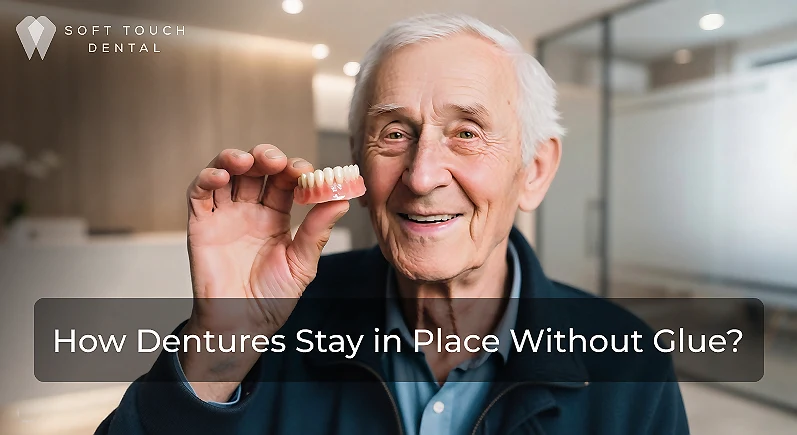
Well-made dentures stay in place mainly through natural suction and a thin film of saliva between the denture and your gum tissue, not glue. A close-fitting upper denture forms a seal against the roof of your mouth the same way two wet pieces of glass cling together, while a lower denture relies more on your tongue, cheeks, and lips holding it steady, since there’s no palate to seal against. Adhesive is meant to be a supplement to that fit, not a replacement for it.
What Actually Holds a Denture in Place Without Adhesive?
The main mechanism is suction, created when a denture’s base is shaped to match the exact contours of your gums and jaw ridge with almost no gap in between. That close contact, combined with a thin layer of saliva acting like a seal, produces a gentle vacuum that resists the denture pulling away from the tissue. This is the same reason a well-fitted denture can feel like it’s “stuck” in place even before you clench your jaw, and it’s also why a denture that no longer fits precisely, because your gums and bone have changed shape, loses that seal and starts to feel loose no matter how much adhesive you add.
Why Do Upper Dentures Stay In More Easily Than Lower Dentures?
Upper dentures have a built-in advantage: they cover the palate, which gives them a large, relatively flat surface area to seal against. That broad contact area is what makes suction so effective on top. Lower dentures don’t have that option, since the tongue sits in the space where a palate would be, so a lower denture only has a narrow horseshoe-shaped ridge to rest on. That smaller footprint is the main reason lower dentures are almost always less stable than upper ones, and it’s why patients so often ask about implant-supported options specifically for the lower jaw.
How Do Your Muscles Help Keep Dentures Secure?
Once you’ve worn dentures for a while, your tongue, cheeks, and lips learn where to apply gentle, steady pressure to help hold them in position, especially the lower denture. This muscle control develops gradually, which is one reason new denture wearers often struggle more in the first few weeks than they do a few months in. Chewing evenly on both sides, speaking slowly at first, and practicing with softer foods all help your muscles adapt faster to working with the denture instead of against it.
Can Bone Loss Make a Well-Fitting Denture Start to Feel Loose?
Yes, and this is the most common reason a denture that used to fit well stops feeling secure. After teeth are lost, the jawbone that used to support them gradually resorbs, meaning it shrinks and reshapes itself over months and years. As that happens, the ridge your denture was originally molded to fit no longer matches its current shape, the seal weakens, and suction becomes less reliable. This isn’t a sign anything was done wrong originally, it’s a normal, expected part of wearing dentures, which is why periodic relines are considered routine maintenance rather than a fix for a mistake.
Do Partial Dentures Stay in Place the Same Way as Full Dentures?
Partial dentures get extra help that full dentures don’t have: metal or acrylic clasps that hook around your remaining natural teeth. Those clasps provide a mechanical grip in addition to the same close-fit suction principle, which is why many partial denture wearers need little to no adhesive at all. The trade-off is that a partial denture’s stability depends on the health of the natural teeth it’s clasped to, so keeping those teeth strong is directly tied to how secure the partial feels.
When Should You See a Dentist Instead of Just Using More Adhesive?
Reaching for more adhesive is a reasonable short-term fix, but if you find yourself needing noticeably more than you used to, or your denture still shifts when you talk or eat, that’s usually a sign the fit itself has changed and needs to be addressed, not a sign you need a stronger glue. A dentist can tell fairly quickly whether the issue is a straightforward reline or something that calls for a different type of denture altogether.
How Do Implant-Supported Dentures Solve the Retention Problem Completely?
Implant-supported dentures anchor directly to small titanium posts placed in the jawbone, which click or snap the denture into a fixed, predictable position. Because retention comes from a physical connection to the implants rather than suction or muscle control, this option removes the loosening problem almost entirely, including for lower dentures, which is where traditional dentures struggle the most. It’s a bigger step than a standard denture, but for patients who’ve fought with slipping and adhesive for years, it’s often the more permanent answer.
If your denture has started to feel less secure than it used to, that’s worth having looked at rather than adjusting to it. Schedule a visit and we’ll confirm whether a reline, a new denture, or an implant-supported option is the right next step.
Compare your denture options in San Diego with Dr. Fakhimi.