

If you’re replacing a full arch of teeth, you’ve probably seen two options come up again and again: All-on-4 and All-on-6. They’re closely related — both give you a full set of fixed teeth anchored to dental implants — and the “right” one depends on your jawbone, your goals, and your budget. At Soft Touch Dental in San Diego, Dr. Ali Fakhimi has placed both for more than 25 years. Below, we break down exactly how they differ, who each one suits, and how to decide.
The Short Answer
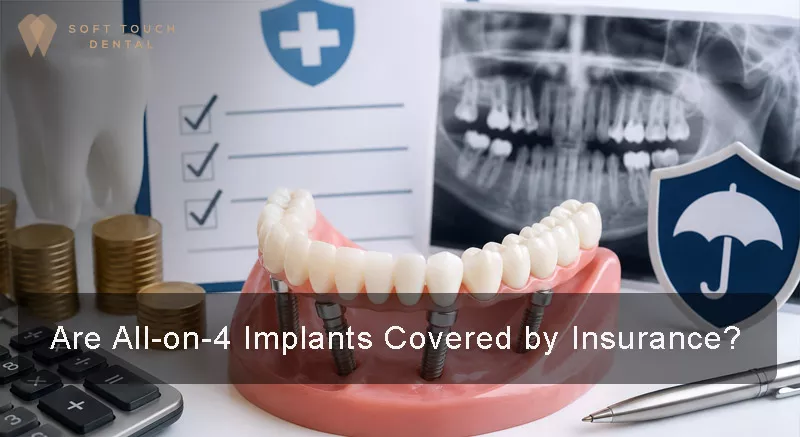
All-on-4 uses four implants to support a full arch of fixed teeth. It’s the most efficient, cost-effective full-arch option, and its angled placement often lets patients avoid bone grafting — even when some bone has been lost.
All-on-6 uses six implants to support the same full arch. The two extra implants add support and spread biting forces over more anchor points, which can be an advantage for patients with more bone available or those wanting maximum stability.
Both can often deliver a fixed set of teeth the same day (see Teeth in a Day). Neither is universally “better” — the best choice is the one that matches your anatomy and goals, which a 3D scan and exam will reveal.
What Is All-on-4?
All-on-4 replaces an entire arch (upper or lower) with just four dental implants. Two implants are placed straight at the front of the jaw, and two are angled toward the back. That angling is the clever part: it lets the implants anchor into denser, more available bone and often avoids the need for bone grafting, even in patients who’ve worn dentures for years and lost some bone.
Because it uses fewer implants and less surgery, All-on-4 is typically the more affordable and faster path to a fixed full-arch smile. Learn more on our All-on-4 implants page.
What Is All-on-6?
All-on-6 follows the same idea but uses six implants per arch instead of four. The additional two implants create more points of support along the jaw, which can distribute chewing forces more evenly and add stability to the final restoration — particularly on the upper jaw, where bone tends to be softer, or for larger full-arch bridges.
All-on-6 generally requires more available bone (or grafting to build it up) because there are more implants to place. For the right candidate, it can be an excellent long-term foundation. Learn more on our All-on-6 implants page.
All-on-4 vs. All-on-6: Side-by-Side Comparison
| All-on-4 | All-on-6 | |
|---|---|---|
| Implants per arch | 4 | 6 |
| Support & force distribution | Excellent for most patients | Maximum — spread over more anchors |
| Bone requirements | Lower — often avoids grafting | Higher — may need adequate bone or grafting |
| Typical cost | More affordable per arch | Usually higher (two more implants) |
| Surgery & healing | Less invasive, faster | Slightly more involved |
| Same-day teeth possible | Yes | Yes |
| Best suited for | Moderate bone loss, efficient restoration | More available bone, maximum stability |
Every mouth is different. This table shows general tendencies — your exam and 3D scan determine what’s actually right for you.
How Do I Know Which One I Need?
The decision comes down to a few clinical factors your dentist evaluates:
Your bone volume and density. A 3D CT scan shows exactly how much healthy bone you have and where. More bone opens the door to All-on-6; less bone often points toward All-on-4’s graft-avoiding design.
Which arch you’re treating. The upper jaw has softer bone and sinus cavities to work around, so some patients benefit from the extra support of All-on-6 up top while All-on-4 works beautifully on the lower.
Your bite and chewing forces. Patients who grind their teeth or have a heavy bite may be steered toward more implants for durability.
Your budget and timeline. All-on-4 is usually the more economical route to a fixed smile, and financing can make either option manageable — see our dental implant cost guide.
There’s no substitute for an exam. The honest answer to “which is right for me?” almost always requires a 3D scan — and that’s exactly what a free consultation is for.
What They Have in Common
Whichever you choose, you get the same core benefits:
- A full arch of fixed, non-removable teeth that stay in your mouth like natural teeth
- Preserved jawbone — implants stimulate bone the way natural roots do, unlike dentures
- Restored bite strength to eat the foods you love
- A natural-looking, custom-designed smile
- The option of a fixed set of teeth the same day with immediate-load implants
- A single, coordinated treatment instead of replacing teeth one at a time
Why Choose Soft Touch Dental in San Diego
- Dr. Ali Fakhimi — 25+ years of implant and cosmetic experience, 1,000+ successful cases, and advanced training from LVI, the California Implant Institute, and the 4M Dental Implant Institute
- 3D-guided digital planning for precise, predictable full-arch results
- Comfortable, sedation-friendly care in a spa-inspired setting
- Two convenient San Diego locations — Clairemont and Bankers Hill
- Hundreds of 5-star reviews from San Diego patients
Frequently Asked Questions
Is All-on-6 better than All-on-4?
Not inherently — neither is universally better. All-on-6 adds two implants for extra support and is often chosen when there’s enough bone or when maximum stability is the goal. All-on-4 is more efficient, more affordable, and often avoids grafting. The right choice depends on your bone, your bite, and your goals.
Is All-on-6 more expensive than All-on-4?
Usually, yes — two additional implants generally means a higher cost. The difference varies by case and materials. Financing is available for both.
Can I get either one in a single day?
Often, yes. Both All-on-4 and All-on-6 can be delivered as “Teeth in a Day” using immediate-load implants, so you leave with a fixed set of temporary teeth the same day and receive your permanent teeth after healing.
Do I have enough bone for implants?
Many patients told they “don’t have enough bone” still qualify — especially for All-on-4, which is designed to use available bone and avoid grafting. A 3D scan is the only way to know for sure.
How long do All-on-4 and All-on-6 implants last?
With good care, the implants themselves can last a lifetime. The fixed teeth attached to them are durable and can be maintained or replaced over time without redoing the implants.
Still Not Sure Which Is Right for You?
That’s completely normal — and it’s exactly what a consultation answers. Book a free consultation at Soft Touch Dental in San Diego. Dr. Fakhimi will take a 3D scan, review your options, and give you a clear, honest recommendation. Call (858) 274-8200 today.