





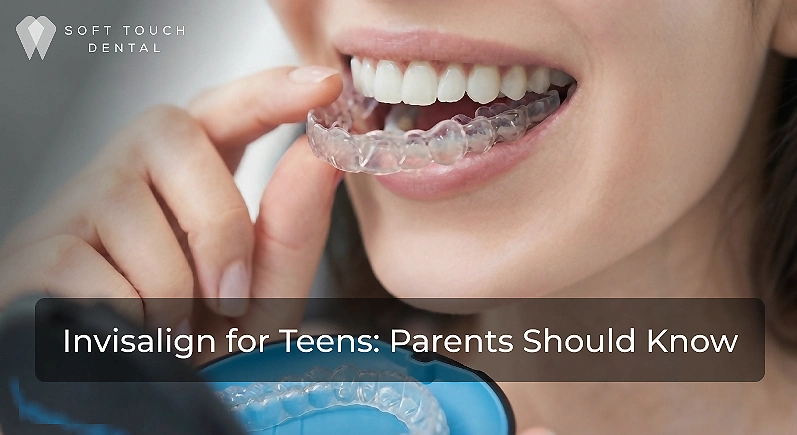
The Question Every Parent Actually Wants Answered
It’s rarely “does Invisalign work for teenagers” that parents are really asking. It’s “will my teenager actually wear it.” Fair question — traditional braces don’t give a 15-year-old the option to skip them for a day, and clear aligners technically do. Invisalign for teens was built almost entirely around solving that one problem, and it’s worth understanding how before deciding it’s either perfect or a bad idea for your specific kid.
What’s Actually Different About Invisalign Teen
The aligners themselves look and function like the adult version, but the system built around them isn’t the same product with a younger label slapped on. Invisalign Teen includes built-in eruption tabs that account for teeth still coming in (something adult treatment doesn’t need to plan around), and a handful of replacement aligners included for a lost or damaged tray — because that happens more often at 14 than it does at 40.
Then there’s the compliance indicator: a small blue dot embedded in the plastic near the back molars that gradually fades to clear the longer the tray is actually worn each day. It’s calibrated to react to saliva enzymes and body temperature specifically, so it can’t be faked by leaving a tray in a glass of water overnight. By the end of a two-week cycle, a mostly-clear dot means the aligner was worn close to the recommended amount. A dot that’s still visibly blue is a fairly direct signal that wear time is falling short — which turns a vague argument about whether trays are “basically” being worn into something a parent and an orthodontist can just look at.
Is Your Teen a Good Candidate?
This is less about age and more about a few practical questions worth answering honestly before committing to a full treatment plan:
- Can they manage removing trays for every meal and snack? Aligners have to come out to eat and drink anything but water, which means several times a day, every day, for months.
- Are they generally responsible with small objects they’re expected not to lose? A retainer case habit matters more here than most parents expect going in.
- Is the orthodontic issue actually a good fit for aligners? Mild to moderate crowding, spacing, and bite issues tend to respond well. More complex bite corrections or significant jaw discrepancies sometimes still call for traditional braces, and a good orthodontist will say so rather than push aligners as a one-size answer.
The American Association of Orthodontists recommends every child have an orthodontic evaluation by around age 7, well before most teen treatment actually begins — that early check is about catching issues while jaws are still developing, not about starting aligners early. By the time Invisalign Teen is actually appropriate, most kids are old enough that the compliance conversation is the real deciding factor, not eligibility.
Where Compliance Actually Breaks Down
In practice, it’s rarely one dramatic act of defiance — it’s small erosion. Trays left out during a sleepover. Forgetting to put them back in after lunch at school and not noticing for three hours. A tray that “should be around here somewhere” that turns into a missing week of treatment. None of this means Invisalign was the wrong call; it usually means the daily system around it — a case that lives in a backpack, a phone reminder, checking in at the two-week mark rather than assuming everything’s fine — needed to be more built-in from day one.
What Parents Underestimate Going In
Cost conversations tend to happen early, and comfort conversations tend to happen never — until week one, when a new tray feels tight and a teenager reports it like something has gone wrong. It usually hasn’t. Mild pressure for the first day or two of each new tray is the treatment working, not a problem, and it’s worth telling your teen that up front so the first uncomfortable morning doesn’t turn into a request to stop wearing them.
Common Questions
Can Invisalign Teen fail if my teenager isn’t fully compliant?
Yes — inconsistent wear is the single biggest reason teen treatment takes longer than planned or needs refinement aligners partway through. The compliance indicators exist specifically because this is common, not rare.
Is Invisalign more expensive than braces for teens?
Costs are generally comparable and depend heavily on the complexity of the case. It’s worth discussing directly during a consultation rather than assuming either option is automatically cheaper.
What happens if a tray gets lost?
Invisalign Teen builds in a small number of replacement aligners for exactly this reason. It’s an expected part of treating teenagers, not an emergency.
Should a nervous or very busy teen just get braces instead?
Not necessarily — some teens who seem like poor candidates on paper do fine once the daily habit clicks, and some highly responsible teens still lose trays constantly. It’s worth an honest conversation with your orthodontist about your specific kid rather than assuming personality type predicts outcome.
The Takeaway
Invisalign for teens works when the daily habit is built in from the start — a case, a routine, and realistic expectations about the first day of each new tray. It’s not a lower-commitment version of braces; it’s a different kind of commitment, one that depends on your teenager rather than a bracket doing the work automatically. For most families, that trade is worth it. For some, traditional braces are genuinely the better fit, and there’s no harm in saying so during a consultation.
If you’re still weighing the two options against each other, this comparison is a good place to start, and our Invisalign page covers what a first consultation actually looks like for a teenager at Soft Touch Dental.
Book a consultation for Invisalign for teens and adults in San Diego at Soft Touch Dental.