





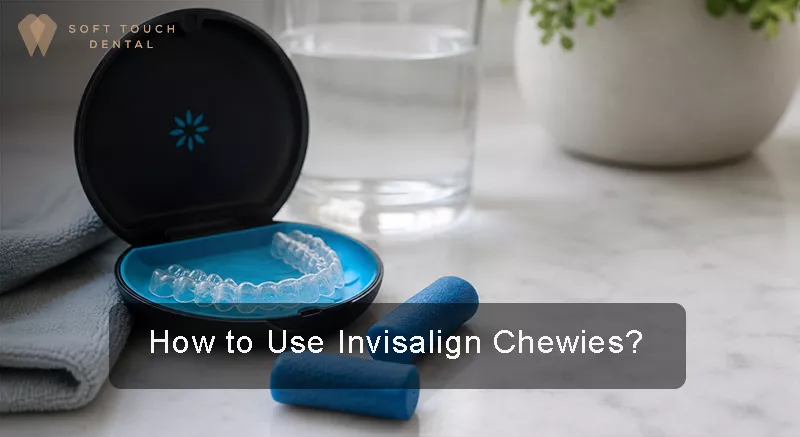
Invisalign chews are small, soft, cylindrical pads (about the size of a cotton ball) made of flexible plastic or silicone. Orthodontists give them to patients as a tool for fitting aligners. After you place the aligner tray on your teeth, you place a chew between your top and bottom teeth and bite down gently. The repeated biting action presses the clear tray firmly against your teeth, eliminating small air gaps and helping the aligner to fit your teeth exactly as it is intended. This tight fit is crucial, as each new tray moves your teeth just a fraction of a millimeter, and the chews ensure that pressure is applied evenly and precisely. In fact, Invisalign’s own materials explain that chewables help correctly position your aligners for a more precise and secure fit and reduce uneven pressure points for greater comfort. By closing these gaps, chews help keep your treatment on track and may even prevent small tracking errors that could otherwise delay your progress.
How to Use Invisalign Chewables
Using Invisalign Chewables is simple, but doing it correctly will maximize its benefits. First, place your aligners fully in your mouth as usual. Once the tray is in place, take a chew and place it between your top and bottom teeth. Then:
Bite gently: Bite on the chew and hold for a few seconds to hold the tray in place.
Roll and repeat: Move the chew to a new spot in your mouth (like the front or each side) and bite again. This ensures that each area of your teeth is put under pressure. Move in sections of your bite and bite and hold several times.
Continue chewing: Continue chewing the chew for a short session (5 to 10 minutes total). You can do this by biting down on one side for about 5 seconds on each side, then continuing until you have covered all the areas.
In practice, you might bite down on one side of the chew for 5 seconds, then move it to the next tooth and bite down again, repeating this cycle for a few minutes in each position. The goal is to feel the aligner fully contact each tooth. Do this in short bursts and chew slowly, not forcefully. When you are done, remove the chew and continue using your aligner. Wash the chew with warm water or mild soap to keep it hygienic.
How much and how long to use chews
Chews are usually used several times a day to keep your aligners in place. Orthodontists recommend using chews every time you put in or change your aligners, especially when you start wearing new aligners. Key points include:
After putting in new aligners: You will often feel a bit stiff or loose for the first day or two with your new aligners. Chewing right after putting in your aligners will help them stay in place.
- After meals: Use chews when putting them back in whenever you take them out to eat and then brush your teeth.
- If you feel any looseness in an area: Feel around the edges of your aligners. If you notice a gap or a tooth that is not completely covered, bite down on the side with the chew to help it settle into place.
- Before bed: Chewing for a few extra minutes at night can help ensure that your aligners are fully seated during uninterrupted wear, when the most tooth movement occurs.
Many orthodontists specifically recommend using chews for 5 to 10 minutes a day (often before bed) to hold your trays in place overnight. A typical routine might be 5 minutes in the morning after you put your aligners in, 5 minutes after lunch, and another 5 to 10 minutes before bed. The key is consistency: short chewing sessions throughout the day (or each time you put your aligners in) are most effective.
Benefits of Invisalign
Invisalign is a modern and discreet way to straighten teeth using clear, removable aligners that help maintain the natural appearance of your smile throughout treatment. Because the aligners can be taken out for eating, brushing, and flossing, they offer greater convenience and comfort than traditional braces. With its nearly invisible design and effective treatment results, Invisalign is an excellent option for people looking to improve their smile without significantly changing their daily routine.
Improved Aligner Fit:
By eliminating air pockets, invisible braces help each aligner stay firmly and securely in place. A tighter fit means the aligner can apply its planned force more accurately, resulting in more efficient tooth movement.
Faster and More Predictable Progress:
When aligners are properly fitted, you are less likely to experience “tracking” issues where teeth don’t move as planned. This can translate into smoother progress toward your smile goals. While invisible braces won’t literally shorten your doctor’s prescribed timeline, they can prevent minor delays caused by loose trays. By keeping you on schedule, invisible braces can help you complete your treatment on time.
Greater comfort:
An aligner that is well-placed is more comfortable. Invisible braces help distribute force evenly and reduce pressure points. Patients often find that using chewables reduces the pain associated with wearing a new tray by preventing uneven contact. Chewables reduce pressure points and make daily wear less uncomfortable.
Fewer adjustments needed:
When trays are properly placed every time, you are less likely to need additional corrective trays later. Chewables act as your orthodontist’s assistant, helping each aligner do its job. Consistent use reduces the risk of treatment failure or extension.
Conclusion
Invisible chews are a simple but powerful tool to enhance your clear orthodontic treatment. By biting on a soft chew for a few minutes at key times each day, you help your trays stay in place and exert their full corrective force. This results in better tracking, greater comfort, and fewer treatment problems. If you’re unsure about your technique or how often to use them, talk to your orthodontist or a trusted dentist in San Diego. They can show you how to use them properly and make recommendations tailored to your schedule. When searching for an orthodontic provider or office, try Invisalign near me, this will help you find local professionals who know how to use the chews properly and can answer any questions you may have.
FAQs
How do you use Invisalign chews?
After your aligner tray is in place, take a chew and place it between your top and bottom teeth. Bite firmly but gently for a few seconds, then move the chew to another area and bite again. Hold the chew for about 5 seconds at each point. Repeat this process throughout your mouth to press all areas of the tray in. Try to chew for 5 to 10 minutes each session.
How often should I use the chews with my Invisalign?
It’s best to use the chews every time you put in or adjust your aligners. In practice, this means once after putting in a new tray and again every time you take out and put back in your aligners (after eating or brushing your teeth). Many people chew for a few minutes in the morning and a few minutes at night to fully cover their teeth.
How long should I chew with Invisalign Chewies each time?
It is recommended that you chew each aligner for about 5 to 10 minutes per session. For example, you might chew on a chewie for 5 minutes after your aligners are placed in the morning and another 5 to 10 minutes before bed.
Are chewies necessary for invisible aligners?
Although not strictly necessary, chewies are highly recommended by orthodontists. They are a simple tool that helps ensure that each aligner is doing its job. Many offices recommend that chewies be used at all times, especially early in treatment, to prevent any gaps that could slow progress. In other words, you can get Invisalign without aligners, but removing them may mean less precise tooth movement and potential delays.
Can aligners speed up my invisible orthodontic treatment?
Aligners won’t magically shorten your treatment timeline, but they can help keep your treatment on track. Aligners help keep your treatment on track by helping to ensure the precise placement of each aligner. In a way, they remove minor roadblocks—without them, ill-fitting trays can mean your teeth don’t move as planned each week. So aligners can help prevent unexpected delays.