





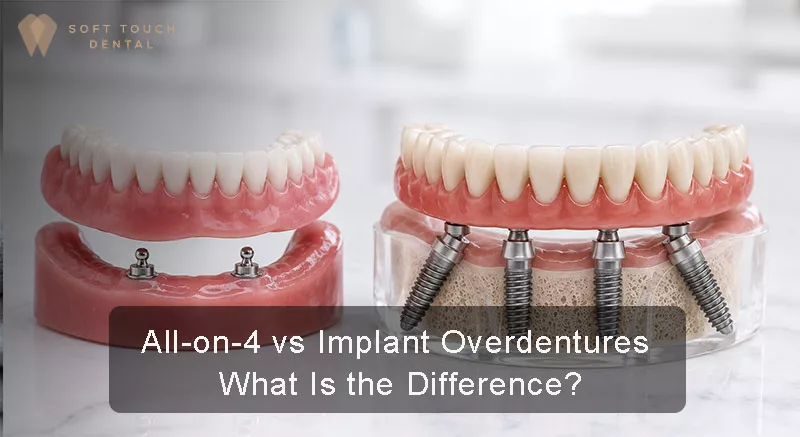
For complete upper tooth replacement, patients often compare implant-supported overdentures to All-on-4 solutions. Both use dental implants to replace the entire jaw, but they are fundamentally different. Simply put, an implant-supported overdenture is a removable denture that is anchored to implants, while All-on-4 uses four permanent implants to hold a fixed bridge in place. Choosing between the two depends on factors such as jawbone, bite force, cost, and maintenance.
When considering full mouth dental implants, patients often compare implant overdentures with All-on-4 as two popular solutions for restoring an entire arch of missing teeth. Understanding the different types of dental implants can help patients better understand their options for replacing missing teeth. Traditional dental implants are used to replace single teeth, while multiple implants can support removable overdentures or full-arch fixed restorations such as All-on-4. The best option depends on the number of teeth missing, available jawbone, oral health, budget, and personal treatment goals.
Key Differences Between Overdentures and All-on-4
Key differences between overdentures and All-on-4 include durability, design, maintenance, and long-term performance. While both use dental implants to completely restore a missing dental arch, the right choice depends on a variety of factors, which we will discuss below:
Design – Removable vs. Fixed
An implant-supported overdenture is a removable prosthesis that is attached to 2 to 4 implants in the jaw. It is removable for cleaning and is usually smaller and lighter. In contrast, an All-on-4 is a fixed full-arch bridge that is screwed to four angled implants. It never comes out of your mouth (except by a dentist) and looks more like natural teeth. In other words, overdentures are easy to remove and clean, while All-on-4 bridges are permanent and provide maximum stability.
Number of Implants and Bone Requirements
Overdentures use fewer implants (often 2 to 4 per arch) and can sometimes be made with as few as two, reducing surgical time and cost. All-on-4 always uses four implants (two vertical implants in the front and two tilted implants in the back) to maximize bone contact. The tilted placement of All-on-4 often allows it to avoid bone grafting by using denser bone in the front. Sometimes, an overdenture can be done with fewer implants in the front if bone is limited.
All-on-4 vs. All-on-6 Dental Implants
When comparing All-on-4 vs. All-on-6 dental implants, the main difference is the number of implants used to support a full arch restoration. All-on-4 uses four strategically placed implants, while All-on-6 uses six implants to provide more support and distribute chewing forces throughout the jaw. All-on-6 is recommended for patients who have sufficient bone volume and want more stability, while All-on-4 can be a good option for patients who have little bone available or who are looking for less implant treatment. However, the choice between the two depends on factors such as bone density, bite forces, oral health, and the patient’s individual treatment plan.
Stability and chewing strength
All-on-4 provides 24/7 anchorage, creating the strongest bite possible. A fixed All-on-4 bridge allows you to bite and chew as well as natural teeth and makes it easy to eat hard foods. An overdenture is much more stable than a regular denture, it will not come out with a strong bite but can move slightly under heavy chewing. Overdentures often exert about 50 to 60 percent of the natural biting force, while fixed dentures can reach 80 to 90 percent.
Cleaning and Maintenance
Since overdentures are removable, cleaning them is simple: You simply remove them each night to brush and soak. The person also cleans around the implants in the gums. However, the attachment parts (clasps, locators, bars) wear out and need to be replaced every 1 to 2 years. All-on-4 bridges are cleaned like natural teeth with a soft toothbrush, floss, or water flosser daily. You cannot remove the bridge yourself; instead, you clean under and around it using special brushes and liquid dental floss. Professional cleanings are recommended for both options twice a year.
Cost and durability
In general, implant-supported overdentures have a lower initial cost because they use fewer implants and are easier to fabricate. All-on-4 requires more extensive lab work (a full-arch bridge), so the initial investment is higher. However, in the long run, overdenture patients may pay more for denture replacements: denture bases need to be relined or extended as the gums change, and the attachment clips need to be replaced periodically. An All-on-4 bridge (especially if made of a strong material like zirconia) can last 15 to 20 years or more without needing a full restoration.
An overdenture snaps onto the denture and is cheaper/easier to clean, while All-on-4 is fixed for stronger chewing and a more lifelike feel.
Dr.Fakhimi DMD
Who is a good candidate for an overdenture or an all on 4?
When comparing Overdenture vs All on 4 dental implants, the choice between these options depends on several patient-specific factors:
Bone quantity:
All-on-4 is designed for situations with limited bone. Its dorsolateral implants engage denser anterior bone, often avoiding a graft. Even with moderate bone loss, many patients can have All-on-4 without a major graft. Overdentures use fewer implants and can often be done on less bone, but if the bone is very thin, the dentist may recommend a graft or placement of alternative implants (such as mini or zygomatic implants).
Oral health and habits:
Both treatments require good oral hygiene and health (non-smokers do better, diabetics need to be controlled, etc.). All-on-4 requires careful cleaning under the bridge to prevent peri-implantitis. Overdentures are a little easier for patients with poor hygiene because they can be soaked and gums cleaned when the dentures are removed.
Lifestyle and Preferences:
If you prefer a solution that does not require removal, the All-on-4 fixed bridge gives you the feel of permanent teeth. If chewing strength and a natural feel are top priorities, this bridge is ideal. Patients who love to brush and floss like natural teeth (without having to remove them at night) often choose All-on-4. If you prioritize lower initial cost, easier maintenance visits, or the convenience of removing dentures (for travel or convenience), an implant-supported overdenture may be preferable. Also, very elderly or medically frail patients sometimes prefer overdentures because the surgery is simpler.
Discuss your case with an implant dentist for a personalized consultation. A qualified dentist in San Diego (or your location) will review 3D scans of your jaw, discuss your goals, and recommend the optimal approach.
Conclusion
Both implant overdentures and All-on-4 are excellent full-mouth solutions that vastly improve on traditional dentures. Overdentures give you a removable, cost-effective denture with better stability than conventional dentures, while All-on-4 provides a fixed bridge with maximum chewing power and a very natural feel. In practice, implant overdenture vs All-on-4 is a trade-off between convenience/cost and permanence/strength. The best approach depends on your jawbone, health, and lifestyle. We recommend consulting an implant specialist to evaluate your case. A knowledgeable dentist in San Diego (or elsewhere) can review your scans and guide you toward the right treatment path.
Regardless of choice, both options have high success rates. Keep in mind general dental care – brush and floss daily, attend follow-ups, and report any issues early to avoid complications. (You can learn more about risks like Dental Implant Failure in our related guide.) Ultimately, by weighing the pros and cons above and consulting a professional, you can achieve a full-arch restoration that restores function, aesthetics, and confidence in your smile.
FAQs
Which is better for me: overdentures or All-on-4?
Neither option is universally superior. Implant-supported overdentures and All-on-4 address the same problem in different ways. The right choice depends on your bone volume, chewing forces, health, and budget. Overdentures offer a more mobile, less expensive solution, while All-on-4 offers a more fixed, more natural result.
Can I upgrade from an overdenture to an All-on-4 later?
Often, yes. Implants placed for an overdenture, if properly positioned and fused to the bone, can sometimes be reused as part of an All-on-4 bridge. In many cases, patients start with a two-implant overdenture and later add implants to convert to All-on-4.
Is All-on-4 much more stable than overdentures?
Yes. An All-on-4 prosthesis is permanently fixed and cannot move in your mouth, providing better stability. An implant-supported overdenture is much more stable than a regular denture, but because it is removable, it will move a little during heavy chewing.
What if I have very little jaw bone?
Both solutions can work with bone loss, but in different ways. Overdentures require less bone, so they are often chosen when bone is limited. However, the angled All-on-4 implants can eliminate the need for a graft in many moderate cases.
How much do Implant Overdentures and All-on-4 cost?
Overdentures have a lower initial cost because fewer implants and a simpler denture are used. All-on-4 has higher surgical and lab costs initially. However, in the long term, the number of overdenture components (clamps, denture base relines, new teeth) increases.