
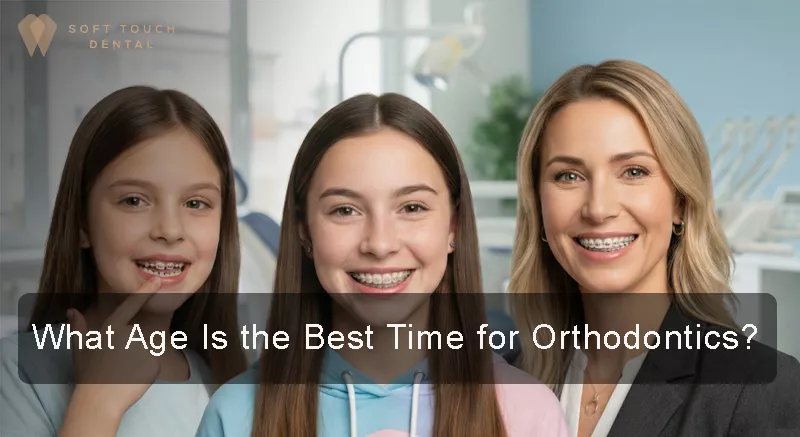
Every parent wants their child to have a healthy, confident smile, but knowing when to start the journey can be confusing. Is age seven too young? Is fourteen too late?
While many assume that braces are a rite of passage reserved strictly for teenagers, the reality is more nuanced. The best time for orthodontics isn’t a single age but rather a window of opportunity that depends on your child’s unique development. While active treatment typically begins between ages 9 and 14, the path to a perfect smile often starts much earlier with a simple observation.
The Rule of Seven – Why Start Early?
The American Association of Orthodontists (AAO) recommends that children have their first orthodontic evaluation by age seven.
At this age, most children have a mix of baby teeth and permanent teeth. This transitional phase offers a unique window for orthodontists to evaluate the growth of the jaw and the eruption pattern of permanent teeth. By spotting subtle issues—like a jaw that is growing too narrow or teeth that are erupting in the wrong direction—we can often intervene before they become complex problems.
For parents seeking Orthodontics in San Diego, this early screening is a complimentary step to ensure peace of mind. It rarely means putting braces on a seven-year-old; rather, it allows us to monitor growth and determine the ideal timeline for treatment.
Warning Signs – When to See an Orthodontist
While age seven is the benchmark for screening, certain visual cues indicate that an evaluation might be needed sooner. If you notice any of the following signs, it is wise to schedule a consultation:
| Warning Sign | Why It Matters |
| Early or Late Loss of Baby Teeth | Losing teeth too soon (due to decay) or hanging on too long can block the path for permanent teeth. |
| Difficulty Chewing or Biting | If your child shifts their jaw to the side to make teeth meet, or frequently bites their cheek. |
| Mouth Breathing | Chronic mouth breathing can alter the shape of the developing jaw and narrow the arch. |
| Thumb Sucking | Prolonged habits (past age 5) can push front teeth forward and reshape the roof of the mouth. |
| Crowded or Misplaced Teeth | If teeth look “stacked,” rotated, or blocked out of the dental arch due to lack of space. |
| Jaws that Shift or Make Sounds | Any popping, clicking, or shifting of the jaw when opening or closing indicates joint issues. |
The Golden Age for Treatment (Ages 9-14)
While early evaluation is key, the actual treatment often begins later. Typically, children between the ages of 9 and 14 are considered the best candidates for braces.
This period is optimal for several reasons:
-
Physiological Sweet Spot
Most of the permanent teeth have erupted, giving the orthodontist a clear picture of the final alignment. However, the jawbones are still growing, which makes moving teeth and guiding jaw structure easier and faster than in adulthood.
-
Psychological Factor
Many peers are wearing braces during these years, so the social stigma is lower. It becomes a shared experience rather than an isolating one.
Phase One vs. Phase Two Treatment
Orthodontic treatment isn’t always a “one-and-done” process. Depending on the severity of the issue, your orthodontist might recommend a two-phase approach.
Phase One – Interceptive Treatment
This phase usually happens early (ages 7-10) while baby teeth are still present. The goal is not to make the smile perfect yet, but to fix urgent structural issues like a crossbite that is shifting the jaw, or severe crowding that blocks permanent teeth. By expanding the jaw or holding space now, we can prevent the need for tooth extractions or jaw surgery later.
Phase Two Comprehensive Treatment
This phase occurs once most or all permanent teeth have erupted (ages 11-15). The goal here is to fine-tune the bite and alignment for a perfect smile. During Phase Two, parents and teens often choose between demon braces and traditional braces depending on the child’s lifestyle and the complexity of the correction needed.
Benefits of Timely Intervention
Treating orthodontic problems at the right time offers significant advantages:
- Creating Room: Early expansion can create space for crowded teeth to erupt naturally.
- Facial Symmetry: Guiding jaw growth can improve the overall balance of the face.
- Reducing Trauma: Protruding front teeth are at high risk of chipping during play or sports; aligning them early protects them from injury.
- Shorter Treatment Time: Fixing structural issues early often means the second phase of braces is shorter and easier.
Is It Ever Too Late for Orthodontics?
A common misconception is that if you missed the boat in your teenage years, you missed your chance for a straight smile. The truth is, there is no age limit for orthodontic treatment.
Adults Can Benefit Too
Healthy teeth can be moved at any age. In fact, nearly one in five orthodontic patients is an adult. Whether correcting a relapse from childhood braces or fixing a lifelong insecurity, adults can achieve excellent results.
Key Differences for Adults
However, adult treatment does come with unique considerations:
- Bone Density: As we age, our bones become denser. This means tooth movement can be slightly slower than in children.
- No Growth to Guide: unlike children, adults have stopped growing. Structural jaw issues that could be guided in a child might require surgery or more complex treatment in an adult.
- Gum Health: Adults are more susceptible to gum disease. It is crucial that gum health is stable before starting treatment to prevent bone loss.
The Importance of a Personalized Timeline
Determining the best time is not just about age; it is about biological readiness. Not every child needs braces at age seven, and not every adult needs surgery.
At Soft Touch Dental, we approach orthodontics with a philosophy of preservation and precision. We don’t rush into treatment. Instead, we monitor your child’s growth and development, intervening only when it yields the most effective and stable results. For our adult patients, we design treatment plans that respect the biology of mature bone and gums, ensuring a healthy outcome alongside a beautiful smile.
Conclusion
So, what age is the best time for orthodontics? The answer is simple: the best time is when the problem is identified.
For children, the ideal benchmark for an evaluation is age seven. This allows us to catch issues early and guide growth. For teens, the golden age of 9-14 offers the most efficient movement. And for adults, the best time is whenever you are ready to invest in your confidence and oral health.
If you or your child are showing signs of misalignment, or if you simply want peace of mind about your dental development, we invite you to schedule a consultation with our team today.