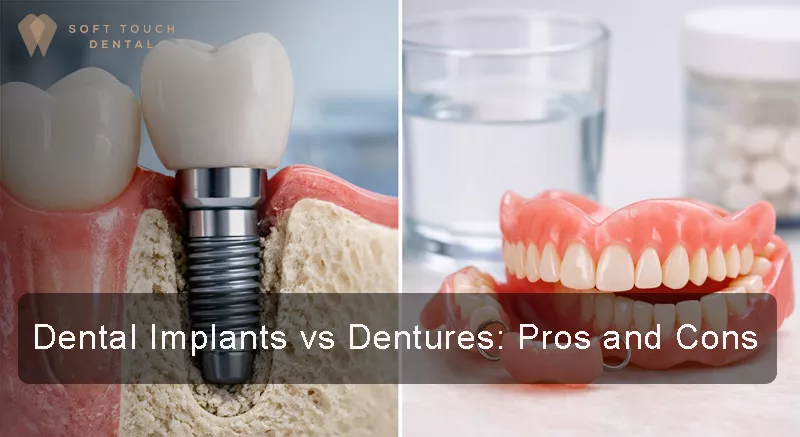
The choice between dental implants and dentures ultimately comes down to permanence, budget, and long-term bone health. Dental implants are surgical, permanent fixtures that act exactly like natural teeth, preserve jawbone density, and can last a lifetime, though they require a higher initial financial investment. Dentures are removable acrylic appliances that rest on top of the gums; they are significantly more affordable and faster to create, but they allow for continuous jawbone deterioration and typically require replacement every 5 to 10 years.
Key Differences Between Dental Implants and Dentures
These two restorative methods have fundamental differences that directly impact the health of your jawbone, gums, and remaining teeth. Recognizing these distinctions helps you choose a treatment that maximizes the longevity of your restoration.
- Support Structure: Implants are anchored directly into the jawbone, acting as artificial roots. Dentures sit on the surface of the gums and rely on suction, adhesives, or adjacent teeth for stability.
- Bone Health: Because implants integrate with the bone, they stimulate the jaw and prevent bone loss. Dentures provide no stimulation to the underlying bone, leading to gradual jawbone shrinkage and changes in facial shape over time.
- Maintenance: Implants are brushed and flossed exactly like natural teeth. Dentures must be removed nightly, soaked in a specialized cleansing solution, and carefully brushed to prevent warping and bacterial buildup.
- Longevity: Dentures wear down and lose their fit as the jawbone changes, requiring replacement every 5 to 10 years. Implants are designed to be a permanent, lifelong solution.
How Do Dental Implants and Dentures Work?
An implant serves as an artificial tooth root integrated directly into your facial skeleton, whereas a denture is a removable prosthetic appliance that sits entirely on top of your soft tissue.
Dental Implants:
A dental implant is a biocompatible titanium post surgically embedded into the jawbone. Over a period of three to six months, the bone fuses to this post through a process called osseointegration. Once fully healed, a custom crown is permanently attached to the top. While traditional methods use standard screws, modern advancements such as Screwless Dental Implants utilize specialized locking tapers or friction-fit mechanisms to secure the crown, offering a seamless and highly durable connection.
Dentures:
Dentures are custom-made oral appliances typically crafted from acrylic resin, sometimes reinforced with a metal framework. A “full denture” replaces an entire upper or lower arch of teeth and rests directly on the gums. A “partial denture” replaces multiple missing teeth and usually features metal clasps that grip onto your remaining natural teeth to stay in place.
Dentures vs Implants Pros Cons
Evaluating the advantages and limitations of both appliances reveals the distinct trade-offs between immediate affordability and long-term functional stability.
Dental Implants:
- Pros: They look, feel, and function like natural teeth. They preserve jawbone density, prevent facial collapse, never slip while speaking or eating, and require no special cleaning routines.
- Cons: The process requires invasive oral surgery, carries a significantly higher upfront cost, and demands a healing period of several months before the final teeth are attached.
Dentures:
- Pros: They provide a fast, non-surgical solution to tooth loss. They are highly affordable upfront, easily adjustable, and can replace an entire arch of teeth in a matter of weeks.
- Cons: They do not prevent jawbone deterioration. They can slip or click during conversation and meals, often require messy dental adhesives, and must be removed from the mouth every night to let the gums rest.
Dental Implants vs Dentures At a Glance
Comparing the clinical requirements and expected lifespans of both treatments helps clarify which financial and medical commitment makes the most sense for your missing teeth.
| Feature | Dental Implants | Dentures |
| Placement | Surgically embedded into the jawbone | Rests on top of the gums |
| Removability | Permanent (Fixed in the mouth) | Removable (Must be taken out nightly) |
| Bone Preservation | Excellent (Stimulates jawbone growth) | None (Jawbone shrinks over time) |
| Maintenance | Standard brushing and flossing | Daily removal, soaking, and special brushing |
| Treatment Time | 3 to 6+ months | 3 to 6 weeks |
| Lifespan | 15+ years to a lifetime | 5 to 10 years |
Should You Choose Dental Implants or Dentures?
Deciding whether to get dental implants or dentures depends entirely on your jawbone density, overall budget, and your desire for a permanent versus a removable solution.
Choose Dental Implants If:
- You have sufficient jawbone density and healthy gum tissue to support the posts.
- You want a permanent solution that functions without dietary restrictions.
- You want to prevent the “sunken face” appearance caused by jawbone loss.
For patients seeking reliable dental implants in san diego ca, this method is universally recognized as the highest standard of care for missing teeth.
Choose Dentures If:
- You lack the necessary bone density for surgery and do not wish to undergo bone grafting.
You are looking for the most budget-friendly, immediate tooth replacement option.
You have medical conditions that complicate or delay healing from oral surgery.
Conclusion
Both methods effectively replace missing teeth, but they serve different long-term goals. Dentures offer a fast, economical, and non-invasive way to restore a smile and basic chewing function, while implants provide a permanent, structural replacement that actively protects jawbone health. At Soft Touch Dental, a thorough clinical evaluation of your jawbone, bite alignment, and lifestyle will ensure you receive the safest and most effective restorative treatment for your individual needs.