
The comparison of Dental Implant vs Bridge shows that each of these tooth replacement methods has its own advantages and disadvantages. In short, dental implants are superior in terms of durability and resemblance to natural teeth and also help preserve jawbone structure, but they require surgery and involve higher costs. In contrast, a dental bridge is completed more quickly and has a lower initial cost, yet it requires trimming the adjacent teeth and needs replacement after 7–10 years. Ultimately, a dentist will recommend the best option based on your budget, oral health condition, and the number of missing teeth.
Key Differences Between Dental Implants and Bridges
The comparison of Dental Implant vs Bridge shows that each option has its own advantages and disadvantages. Dental implants typically offer greater durability and a more natural appearance, while also helping preserve the jawbone structure. However, they require surgery and involve a longer treatment period (several months).
In contrast, a dental bridge can be placed within a few weeks and does not require extensive surgery. Bridges generally have a lower initial cost, but the adjacent teeth must be filed down to support them, and they may need to be replaced over time.
- Support: Implants are anchored directly into the jawbone. Bridges rely on the healthy teeth adjacent to the gap for support.
Impact on Natural Teeth: Bridges require shaving down healthy neighboring teeth. Implants stand completely independent. - Bone Health: Implants stimulate the jawbone and prevent bone loss. Bridges sit above the gumline, allowing the underlying bone to slowly deteriorate over time.
- Treatment Time: Bridges are placed in a matter of weeks. Implants require oral surgery and a healing period of several months.
- Longevity: Bridges typically last 5 to 15 years. Implants can last a lifetime with proper care.
How Do Dental Implants and Bridges Work?
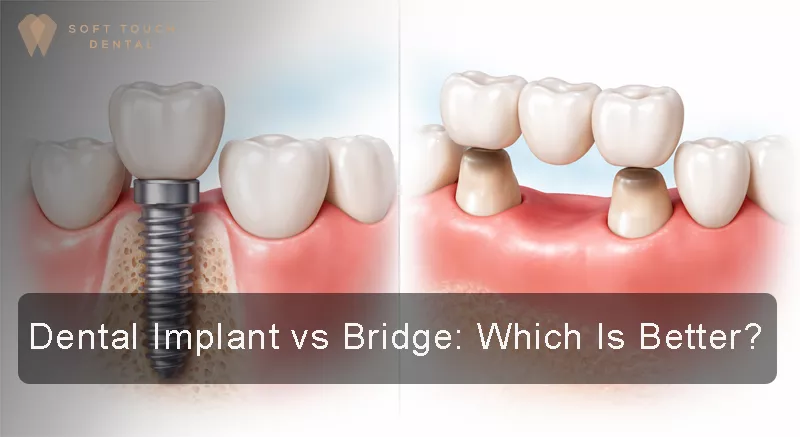
A dental implant is a metal post placed in the jawbone that functions like a natural root, while a bridge replaces a missing tooth using crowns attached to neighboring teeth. understanding how each option is built and anchored inside the mouth is crucial for recognizing their long-term impact on your jawbone and surrounding teeth.
Dental Implants
A dental implant replaces both the root and the crown of a missing tooth. A biocompatible titanium post is surgically placed into the jawbone. Over several months, the bone fuses to this post through a process called osseointegration, creating a permanent anchor for a custom-made artificial tooth (crown).
Dental Bridges
A traditional dental bridge spans the gap left by a missing tooth. It consists of a false tooth (pontic) suspended between two dental crowns. To secure the bridge, the dentist must permanently file down the healthy teeth on either side of the gap (abutment teeth) so the crowns can fit over them and hold the false tooth in place.
Dental Implant vs Bridge Treatment Timeline
The time required to complete each treatment varies significantly due to the surgical and non-surgical nature of the procedures.
The Dental Bridge Timeline: This is a non-surgical procedure usually completed in two visits over a span of 2 to 3 weeks. During the first visit, the adjacent teeth are prepared, impressions are taken, and a temporary bridge is placed. On the second visit, the permanent bridge is cemented.
The Dental Implant Timeline: The dental implants process involves a phased surgical approach. It begins with the surgical placement of the titanium post, followed by a 3 to 6-month healing period while the bone integrates with the metal. Once healed, an abutment is attached, and the custom crown is placed.
Evaluating Bridge vs Implant Pros Cons
Dental implants and bridges are both methods for replacing missing teeth, and each has its own advantages and limitations. In general, implants are considered more durable and closer to natural teeth, while bridges are usually quicker and simpler to perform. Assessing the advantages and limitations of both options reveals the long-term biological and financial impacts of each restorative choice.
Dental Implants:
Pros: They look, feel, and function exactly like natural teeth. They preserve jawbone density, do not damage surrounding teeth, and are highly resistant to decay.
Cons: They require invasive oral surgery, carry a higher upfront cost, and require a healing process of several months. Adequate jawbone density is also required for successful placement.
Dental Bridges:
Pros: They provide a fast, non-surgical solution that restores chewing function and aesthetics immediately. They have a lower initial out-of-pocket cost and are more frequently covered by dental insurance.
Cons: They irreversibly damage the adjacent support teeth, making them more vulnerable to future decay. They do not prevent bone loss under the missing tooth and typically require replacement at least once in a patient’s lifetime.
A Quick Comparison of Dental Implants and Bridges
To simplify the decision-making process, the following table contrasts the most critical factors of each treatment.
| Feature | Dental Implant | Dental Bridge |
| Support Structure | Fused directly into the jawbone | Anchored to adjacent natural teeth |
| Bone Preservation | Yes (Stimulates bone growth) | No (Bone loss continues under the gap) |
| Impact on Other Teeth | None (Stands independently) | High (Requires filing down healthy teeth) |
| Lifespan | 15+ years to a lifetime | 5 to 15 years |
| Procedure Type | Surgical | Non-surgical |
| Treatment Timeline | 3 to 6+ months | 2 to 3 weeks |
| Upfront Cost | Higher | Lower |
| Long-Term Cost | Lower (Rarely needs replacement) | Higher (Needs replacement over time) |
Should You Choose a Bridge or Implant?
The ideal treatment depends entirely on your anatomical suitability, timeline, and long-term oral health goals.
Choose a Dental Implant If:
- There is sufficient jawbone density and healthy gum tissue.
- A permanent, lifetime solution is preferred.
- Preserving the natural structure of adjacent teeth is a priority.
- Preventing facial sagging caused by jawbone deterioration is a concern.
For patients exploring dental implants San Diego, this method is widely considered the gold standard of modern restorative dentistry.
Choose a Dental Bridge If:
- The patient lacks the bone density required for implant surgery and declines bone grafting.
- The teeth adjacent to the gap are already heavily decayed or filled and require crowns regardless.
- A faster, non-surgical solution is necessary.
- Health conditions (such as uncontrolled diabetes or autoimmune disorders) impair surgical healing.
Conclusion
Both dental implants and bridges are proven, effective methods for restoring a complete smile. A bridge serves as a fast, cost-effective solution, while an implant represents an investment in long-term oral health, bone preservation, and the protection of surrounding teeth. At Soft Touch Dental, a thorough evaluation of jawbone health, bite alignment, and medical history ensures patients receive the restoration that best aligns with their clinical needs and financial goals.