
You only get one smile, and it is often the very first thing people notice about you. It defines your personality, influences how you carry yourself in interviews, and even dictates which side of your face you present to a camera.
While perfectly symmetrical faces are incredibly rare, noticeable imbalance can be a source of insecurity. Beyond aesthetics, asymmetry often signals underlying functional issues, such as uneven jaw pressure or temporomandibular joint (TMJ) disorders. The question many patients ask is: Can braces fix a crooked face?
The answer is nuanced. While braces are designed to move teeth, their ability to correct facial asymmetry with orthodontics depends entirely on the root cause of the imbalance. To understand if treatment will work for you, we first need to identify the culprit.
The Mirror Test – Identifying the Source
Asymmetry usually stems from one of two categories: Dental (teeth) or Skeletal (bone). Understanding the difference is crucial for setting realistic expectations. For patients seeking Orthodontics San Diego, we break down these differences below:
| Type of Asymmetry | What It Is | Can Braces Fix It? |
| Dental Asymmetry | The teeth are crowded or tilted, forcing the jaw to shift sideways to close properly (functional shift). The bone itself is often normal. | YES. This is the “sweet spot” for orthodontics. Aligning the teeth allows the jaw to center itself naturally. |
| Skeletal Asymmetry | The jawbone itself has grown unevenly. One side may be longer than the other, or the chin is physically deviated to the left or right. | Maybe. Mild cases can be masked with braces (“camouflage”), but severe cases usually require surgery. |
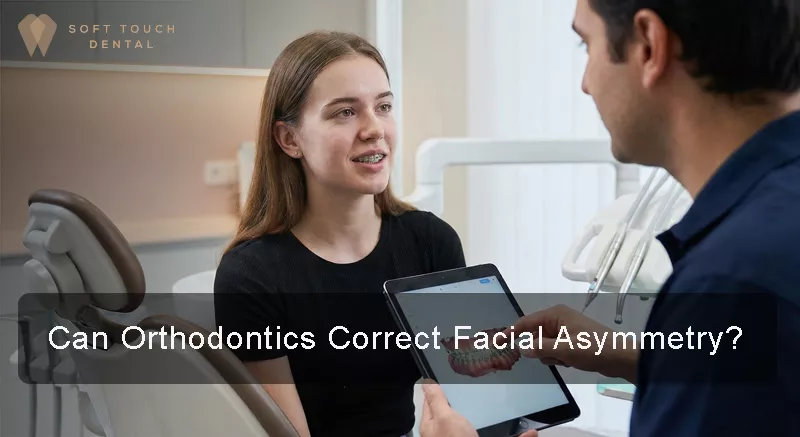
By using advanced imaging during your exam, we can determine if the asymmetry is merely a “functional shift” caused by teeth or a true structural discrepancy in the bone itself.
The Ripple Effect – How Braces Restore Balance
When the asymmetry is dental or functional, orthodontics acts as a powerful corrective tool. It’s not just about straight teeth; it’s about the ripple effect that alignment has on the soft tissue of your face.
Correcting the Functional Shift
The most common form of treatable asymmetry is a functional crossbite. Imagine trying to close a box where the lid doesn’t quite fit; you have to force it to the side to latch it. Your jaw does the same thing. If the upper jaw is too narrow, the lower jaw slides to the side to find a comfortable bite.
By expanding the upper arch and aligning the teeth, braces allow the lower jaw to swing back into its natural, central position. Almost instantly, the chin centers itself, and the facial muscles begin to relax and balance out.
Aligning the Dental Midline
Another subtle but impactful correction involves the “midline”—the line between your two upper front teeth. Ideally, this should line up perfectly with the center of your nose and chin. When this line is off, the entire smile looks tilted. Braces or clear aligners can precisely shift the teeth to align this midline, creating a sense of visual harmony that dramatically improves facial aesthetics.
When Braces Are Not Enough
While modern orthodontics can achieve remarkable results, it is not a magic wand for every type of asymmetry. If the imbalance is purely skeletal—meaning one side of the jaw has physically grown longer or larger than the other—braces alone may not be sufficient. In these cases, we typically look at two distinct paths:
The Camouflage Approach
In mild to moderate skeletal cases, we can sometimes use a “camouflage” technique. By strategically angling the teeth to mask the underlying jaw discrepancy, we can create the illusion of symmetry. The bite becomes functional, and the smile looks balanced, even if the jawbone itself remains slightly uneven.
The Surgical Solution
For severe skeletal asymmetry where the chin is visibly deviated or the bite is impossible to align, a combined approach is the gold standard. In this scenario, braces are used first to align the teeth within each jaw. Then, an oral surgeon repositions the jawbones to align the face perfectly. Finally, braces are used again to fine-tune the bite.
Timing Is Everything: – Growth Modification
The ability to correct asymmetry without surgery is heavily dependent on age. The human face is malleable during childhood, but as we age, the bones harden and fuse.
The Magic of Childhood:
In young children (ages 7-10), the jawbones are still developing. If we detect that the upper jaw is too narrow or growing unevenly, we can use appliances like palatal expanders to gently widen the arch and guide the jaw into a symmetrical growth pattern. This is why the best time for orthodontics regarding facial asymmetry is often in childhood or early adolescence, as we can correct structural imbalances that would require surgery in adulthood.
The Impact of Aging
It is also important to note that our faces change as we age. While bone growth stops in late adolescence, cartilage continues to change, and the loss of collagen can make underlying asymmetries more visible over time. Orthodontic treatment in adults can help support the facial structure, keeping the skin around the mouth tighter and more youthful-looking.
The Hidden Health Connection
While a symmetrical face is aesthetically pleasing, the benefits of correcting asymmetry go far beyond looking good in photos. Facial imbalance is often a symptom of a deeper functional problem that can impact your overall health. When the jaws do not align correctly, the muscles on one side of the face have to work harder than the other to chew or speak.
Correcting this imbalance often resolves the following issues:
- Pain and Dysfunction: Chronic strain on the jaw muscles can lead to temporomandibular joint (TMJ) disorders, tension headaches, and even neck pain.
By correcting the bite, orthodontics allows the muscles to relax, often alleviating years of unexplained discomfort.
- Uneven Tooth Wear: Teeth are designed to fit together like gears. When asymmetry forces a “bad bite,” certain teeth bear excessive pressure while others barely touch. This leads to premature wear, chipping, and even gum recession on the overloaded side. Straightening the teeth distributes these forces evenly, preserving your natural smile for the long term.
Why Expertise Matters
Correcting facial asymmetry is one of the most challenging aspects of orthodontics because it requires a holistic view of the face, not just the teeth. It is a delicate balance of art and science.
At Soft Touch Dental, we do not believe in a one-size-fits-all approach. We analyze your entire facial structure—your chin position, your lip support, and your profile—to create a treatment plan that enhances your natural features. Whether through braces, aligners, or a combined surgical approach, our goal is to achieve harmony that improves both your confidence and your quality of life.
Conclusion
So, can orthodontics correct facial asymmetry?
In many cases, the answer is a resounding yes. By correcting functional shifts, aligning the dental midline, and guiding jaw growth in younger patients, orthodontic treatment can significantly improve facial balance. However, for severe skeletal discrepancies, a combined approach may be necessary.
The only way to know for sure is to stop guessing in the mirror and get a professional diagnosis. If you are ready to explore the possibilities for a more symmetrical, healthy smile, we invite you to schedule a consultation with our team today.